
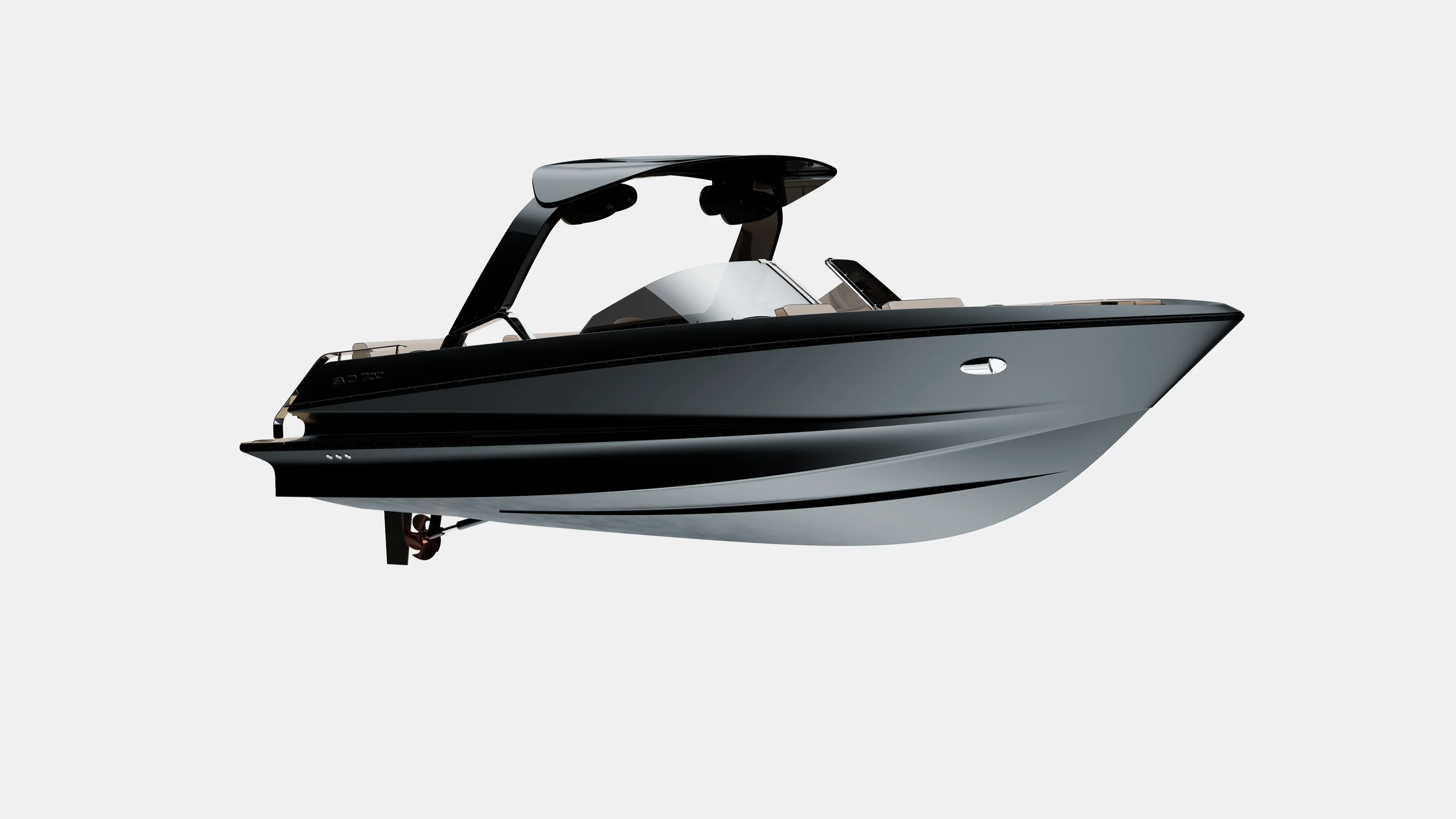
Marian EVO 700 | Full CGI Render
As one of our last clients for 2025, we had the pleasure of collaborating with Marian Boats, a manufacturer of beautiful electric boats based in St. Wolfgang, Austria. The goal of the project was to create stunning visuals of their soon to be released electric wakesurf boat, the EVO 700.
Product visualisation has always been about anticipation. Creating desire before the first prototype ever touches the water. This project was the perfect opportunity to implement a hybrid workflow that we had been experimenting with in recent months, combining 3D and AI. For years, high end 3D rendering set the benchmark. Carefully built scenes, balanced lighting, and detailed textures all served a single goal: realism. That craft still matters. But motion, context, and atmosphere also matter more than ever.
In recent months, the conversation around AI has become louder and louder. Will it replace product photography and 3D workflows for good? The more we use AI at QUIQ, the less we see it as a replacement or as a shortcut that skips fundamentals. Instead, we see it as a powerful extension of a solid and intentional workflow.
The real shift in product visualisation is not about choosing between 3D or AI. It is about understanding how the two perform best together.
3D gives us control.
AI gives us complexity.
When combined thoughtfully, they open a new way of visualising products that is faster, more flexible, and closer to how people experience them in the real world. For products defined by motion, performance, and emotion, like the Marian EVO 700, that difference truly matters.
The Foundation Comes First
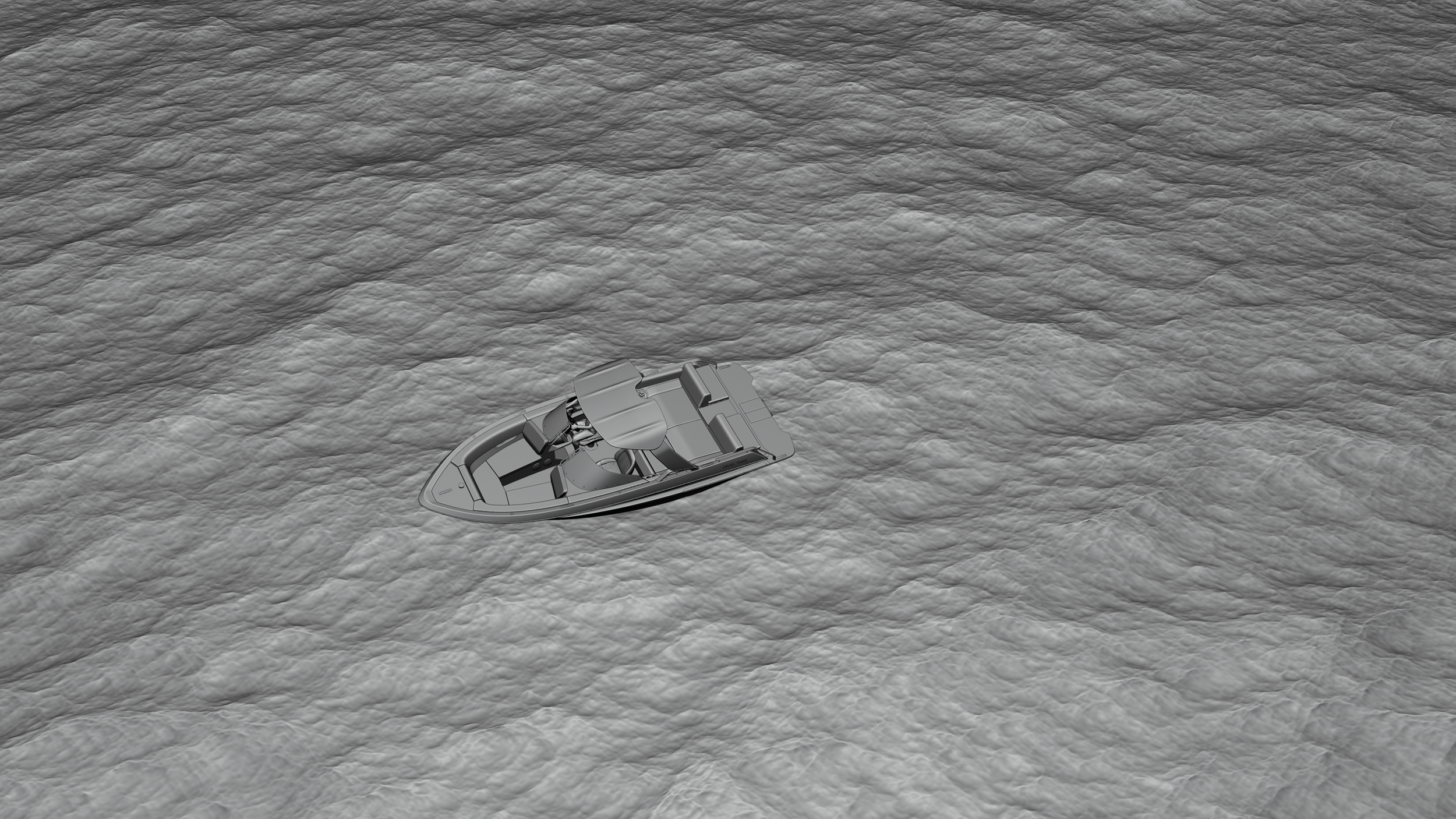
Marian EVO 700 | 3D Scene before texturing and lighting
Every strong visual starts with a solid foundation. Before AI enters the picture, the work begins where it always has: in 3D. For the EVO 700, this meant building a clean and precise scene in Blender. Based on 3D data provided by Marian Boats, we focused on further improving the geometry and applying detailed materials. This stage is about control and intent. It is where the product is defined, not interpreted. Rather than trying to solve everything at once, we focus on what 3D does best: structure, control, and accuracy.
At this stage, we deliberately keep things simple, especially by avoiding complex water simulations. The goal is not to create the final image, but to create the right starting point. Instead of investing time in elements that are difficult, time consuming, or highly organic, we leave space for the next step in the workflow. In other words, we focus on everything that is easy to control and repeat, and keep the difficult stuff for AI.
By doing so, the 3D scene becomes a reliable backbone. One that gives AI something solid to build upon rather than something vague to guess from. This foundation is what allows the hybrid workflow to work. Without it, speed comes at the cost of quality. With it, realism and flexibility can exist at the same time.
Combining 3D and AI

Marian EVO 700 | Full Workflow Breakdown
Once the 3D foundation is in place, the next step is to render an image that is intentionally restrained. This render is not meant to be the final hero shot. It is a controlled, neutral base that already communicates, perspective, atmosphere, lighting and material quality.
The boat is positioned correctly in the scene, but without complex water dynamics or dramatic effects. The goal is consistency and repeatability. A render that can be adjusted quickly and reused across multiple iterations. This is where AI enters the workflow.
Instead of asking AI to invent a product or generate an image from scratch, we feed it a well defined render. One that already contains the right information it can base itself on. The AI’s role is not to reinterpret the boat, but to enhance the scene around it.
This is where AI excels. Adding believable water interaction, wakes, spray, and motion. Introducing atmosphere, depth, and subtle lighting variations that would otherwise require extensive simulation. These elements are highly organic, difficult to control, and time intensive to perfect in traditional 3D workflows.
By letting AI handle this layer of complexity, we gain speed without sacrificing quality. Variations can be explored quickly. Different environments, details and levels of intensity can be tested without rebuilding the entire scene or recalculating complex fluid simulations.This step is where the hybrid workflow truly shows its strength. Precision from 3D combined with richness from AI. Each tool doing what it does best, in the right order, for the right reasons.
What This Workflow Unlocks
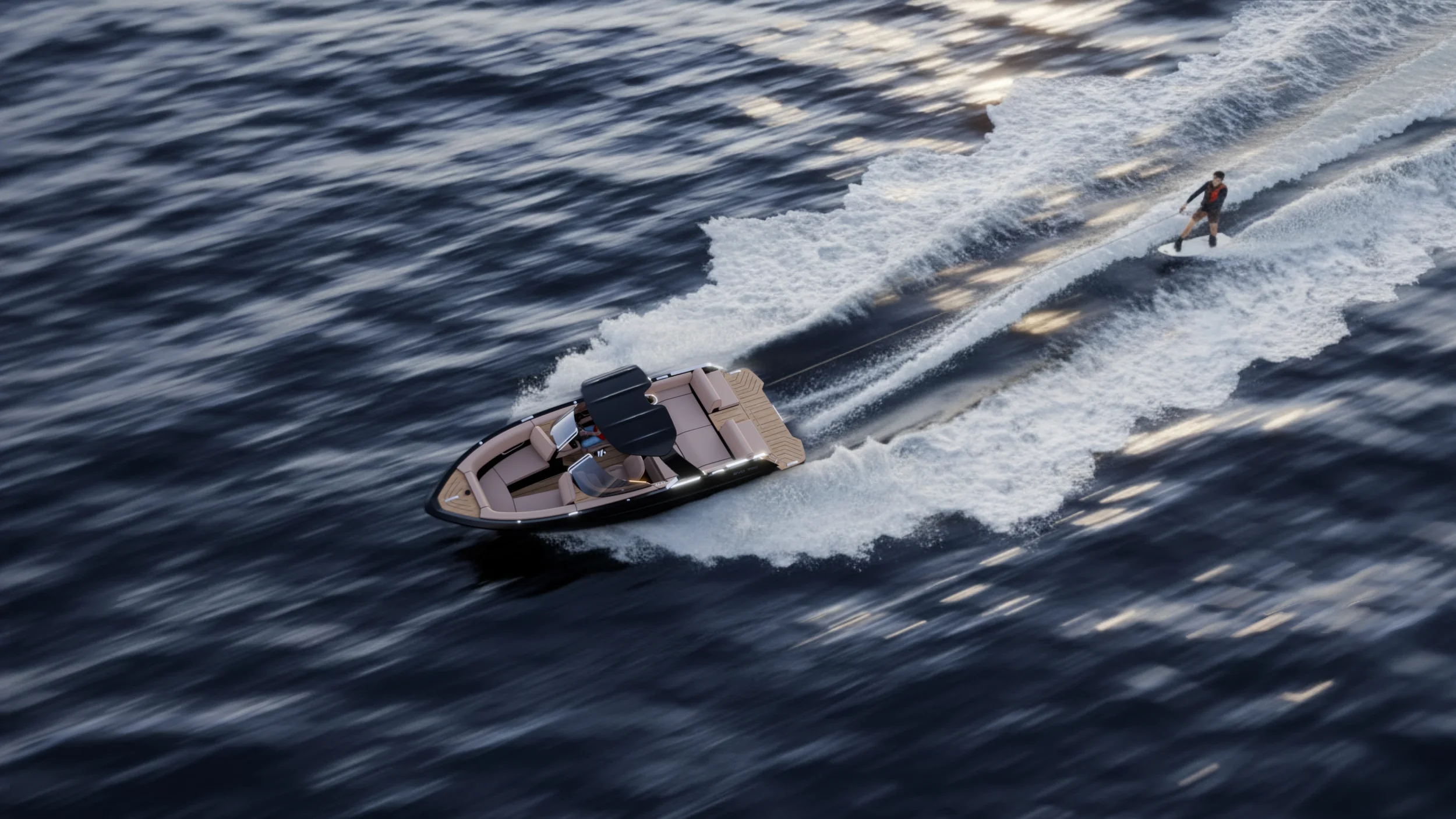
Marian EVO 700 | Final Render
Combining 3D and AI is not about chasing speed for its own sake. It is about creating better visuals, earlier in the process, with more room for exploration and refinement.
For the EVO 700, this hybrid workflow allowed us to move quickly without any compromise. Once the 3D backbone was established, we could explore different visual directions, moods, and levels of intensity with minimal friction. Adjustments that would traditionally require hours of reworking could be tested in a fraction of the time.
This flexibility changes how product visualisation is used. Instead of producing a single final image, visuals become part of an ongoing conversation. They support design decisions, marketing narratives, and brand positioning long before a product is physically available.
For brands like Marian Boats, this means earlier storytelling, stronger alignment between design and communication, and visuals that better reflect how the product is meant to be experienced. Especially for products defined by motion, performance, and emotion, realism is not just about surface detail. It is about energy and atmosphere.
The key takeaway is not that AI replaces established workflows. It strengthens them. When grounded in solid 3D work, AI becomes a tool for amplification rather than approximation.